Would you like to switch to the accessible version of this site?

Go to accessible site Close modal window

Don't need the accessible version of this site?

Hide the accessibility button Close modal window
Accessibility View Close toolbar

(817) 484-2707

JC Logo
Menu
  • Home
  • New Patient Center
    • Online Forms
    • What to Expect
      • Your First Visit
      • Phase 1: Relief Care
      • Phase 2: Corrective Care
      • Phase 3: Wellness Care
  • Payment Options
  • About Us
    • Meet the Doctor
    • Meet the Team
    • Services & Techniques
      • Chiropractic Care
      • Sports and Auto Injuries
      • Alternative Medicine
    • Photo Gallery
    • Video Gallery
  • Testimonials
  • Patient Education
    • All Articles
      • Educational Videos
      • About Chiropractic Care
      • Common Conditions Treated
      • Common Injuries
      • Therapies And Techniques
      • Wellness And Prevention
      • Glossary
  • Contact
  • Book Appointment
  • 3D Spine Simulator
  • Chiropractic Topics
    • About Chiropractic Care
      • What is Chiropractic
      • How Does it Work
      • Who is Chiropractic For
      • Vertebral Subluxation
      • Wellness Resources
    • Common Conditions Treated
      • Auto Accident Injuries
      • Back and Shoulder Pain
      • Body Pain
      • Chronic Condition Relief
        • Conditions Affecting Women
        • Headaches
      • Herniated Discs
      • Improved Health
      • Pediatric Ailments
      • Repetitive Use Injuries
      • Respiratory Function
    • Health & Wellness
      • Healthy Thinking
        • Get Positive
        • Relaxation Techniques
      • Life in Motion
      • Wellness Lifestyle Tips
        • Treat Yourself Well
        • Treat Others Well
        • Eat Well
      • Wellness Essentials
        • At Home
        • At Work
        • Exercise
        • Nutrition
        • What You Wear
      • Wellness Perspectives
        • Mental
        • Spiritual
        • Social
        • Physical
    • Therapies & Techniques
      • Techniques
      • Therapies
    • Newsletter Library
      • Back, Body & Joint Pain
      • Healthy Tips
      • Exercise & Fitness
      • Injury Rehab & Prevention
      • Kid's Health
      • Illness Prevention
      • Chronic Conditions
      • Nutrition & Healthy Eating
      • Breaking Bad Habits
      • Senior Health
      • Weight Loss
      • Pregnancy & Parenting
      • Wellness
      • Mind-Body Connection
      • Stress & Anxiety
      • Life-Work Balance
      • Staying Young
      • Staying Motivated
    • Wellness4Kids
  • Home >
  • Articles >
  • Therapies And Techniques >
  • Spinal Decompression

Spinal Decompression

  • Created in Therapies And Techniques

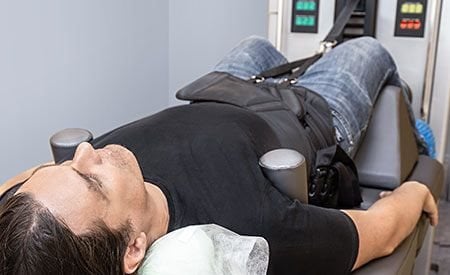
Spinal decompression.

Mechanical Spinal Decompression is a therapeutic technique often used by chiropractors to create space between vertebrae, stretch muscles, and take pressure off nerves and/or the spinal cord. Other terms for spinal decompression are Vertebral Axial Decompression, Spinal Traction or Axial Traction. This technique is non-invasive and generally painless.

Anatomy Affected by Spinal Decompression

The spinal column, or vertebral column, is a remarkably stable structure made up of vertebrae (bones) that protect the spinal cord. Between each of the vertebrae is a disc that is made of cartilage. There are nerves that begin at the spinal cord and travel through a small hole (called a foramen) in the side of each vertebra to the rest of the body. The nerves are responsible for detecting changes in temperature and position as well as signaling muscles and producing pain when the nerves are irritated, injured or damaged. Gravity and physical activity can put pressure on our spinal column throughout each day. That pressure “squeezes” out a little bit of fluid from the discs, and the body rehydrates the disc at night when we are at rest. Imagine a kitchen sponge: When it’s wet, the sponge is softer and can absorb some shock. The more we squeeze it, the more water comes out—but when we add water to a dry sponge, it quickly absorbs the water and puffs up. This is similar to the way our discs work.

Spinal decompression affects the discs and nerves in the spine the most. In a healthy spine, the edges of the vertebrae and discs are stacked on top of one another to form a smooth curve, and the nerves between the vertebrae have plenty of space. However, over time or sometimes because of an injury, degeneration or inflammation, the discs can become flatter. This puts pressure on the nerves and can cause pain, weak muscles, and/or changes in our sense of touch. In these cases, the discs need a little more room to rehydrate and allow for optimal space for the nerves that exit the spinal cord. Spinal decompression works to create some extra space between each of the vertebrae using gentle traction, which in turn helps promote the movement of water, oxygen, and nutrient-rich fluids into the discs.

What Does Spinal Decompression Feel Like?

Spinal decompression feels like gentle, yet strong, stretching of the neck or low back, depending on the area being treated. For example, if the problem is in your lower back, a harness will be placed around your abdomen and just above your hips, and you may have a bolster or a small stool under your legs. The harness should be tight and secure, but not so tight that you can’t breathe comfortably. When the pulling begins, you may feel your entire body shift slightly for a few seconds, and then you will feel a gentle pull on the lower back. We will closely monitor you to make sure there is no discomfort during therapy. A device known as a flexion-distraction table may also be used, which is a flexible table that gently flexes the body in repeated motions to open spaces between the vertebrae.

  • Educational Videos
  • About Chiropractic Care
  • Common Conditions Treated
  • Common Injuries
  • Therapies And Techniques
  • Wellness And Prevention
  • Glossary

Office Hours

Our Regular Schedule

Monday:

8:30 am-12:00 pm

2:00 pm-6:00 pm

Tuesday:

8:30 am-12:00 pm

Wednesday:

8:30 am-12:00 pm

2:00 pm-6:00 pm

Thursday:

8:30 am-12:00 pm

Friday:

8:30 am-12:00 pm

2:00 pm-5:00 pm

Saturday:

Closed

Sunday:

Closed

Location

Find us on the map

Learn About Our Services

Learn About Our Services
  • Copyright © 2026 MH Sub I, LLC
  • Admin Log In
  • Site Map
  • Privacy Policy
  • Terms And Conditions
  • Health Disclaimer